The Garry Winogrand
retrospective at the Metropolitan Museum of Art presents a generous sampling of
the photographer's work, which was first centered around New York City before
encompassing the Midwest and California. His NYC work, shot in midtown
Manhattan in the 1950s and 1960s, captures the city at a time when its
inhabitants were more formally attired and less culturally
diverse than they are today (see above, from 1962). He also
portrayed the turmoil of the late 1960s with portraits of anti-Vietnam war
protests in Central Park and construction worker riots against peace
demonstrators. When Winogrand went west, he depicted a country adrift: faceless
suburbs, self-absorbed pedestrians, a legless veteran at an American Legion
convention, a woman who is a hit-and-run victim lying in the street as a car
drives by. Similar to his peers Diane Arbus and Lee Friedlander, Garry
Winogrand's black-and-white photos have a haunting power.
"Garry Winogrand" continues through September 21, 2014, at the Metropolitan
Museum of Art, 1000 Fifth Ave. at 82nd St., NYC; (212) 535-7710, metmuseum.org
Showing posts with label Metropolitan Museum of Art. Show all posts
Wednesday, March 4, 2015
"Matisse: In Search Of True Painting" At Metropolitan Museum
How did Henri Matisse (1869-1954) achieve such vibrancy of
light and color in his paintings? Apparently by his lifelong habit of reworking
his canvases, as is made evident by "Matisse: In
Search of True Painting" at the Metropolitan Museum of Art. He created
series and pairs of paintings on the same subjects that nevertheless resulted
in startling differences; compare the hue and brushstrokes of "Le Luxe
I" (1907, above left) and "Le Luxe II (1907-1908, right). The
exhibition also includes, among others, varied renderings of still lifes,
domestic interiors, a young sailor, Notre Dame and a dark-haired model,
Laurette. These experiments demonstrate that Matisse remained true to his
mission, in his words, to "push further and deeper into true
painting."
“Matisse: In Search of True Painting” runs through March 17, 2013, at the Metropolitan Museum of Art, 1000 Fifth Ave. at 82nd St., NYC; (212) 535-7710, metmuseum.org.
"Punk: Chaos To Couture" at the Metropolitan Museum of Art
"Punk: Chaos To
Couture" at the Metropolitan Museum of Art traces the punk aesthetic and
its influence on high fashion. The exhibition is replete with multimedia
representations from punk's two former centers, New York and London. There are
videos of punk performances; a recreation of the London shop
"Seditionaries," owned by designers Vivienne Westwood and Malcolm
McLaren, and a recreation of the New York punk club CBGB's notoriously grungy
and graffiti-laden bathroom. The fashion items most representative of punk
culture are Westwood and McLaren's T-shirts, with political and sexual
statements and images designed to shock. Following this look at the early days,
the show surveys punk's influence on current couture–and here its message
becomes muddled. Viewers examine dresses festooned with safety pins, rips,
spikes, studs, chains, splatters of paint and, at times, political statements.
These designs are created by the most prominent names in fashion. It's clear
that, despite the museum's signage stating that the designers are
revolutionaries, they've actually co-opted punk's rebelliousness and created
expensive costumes enabling the wealthy to pose as renegades.
"Punk: Chaos
To Couture" continues through April 14, 2013, at the Metropolitan
Museum of Art, 1000 Fifth Ave. at 82nd St., NYC; (212) 535-7710, metmuseum.org.
"Regarding Warhol" At The Metropolitan Museum
Was Andy Warhol the most
influential artist of the past 50 years? Regarding Warhol: Fifty Years, Sixty
Artists at the Metropolitan Museum of Art goes a long way to proving that he
was. The exhibition covers themes
that are central to Warhol's cannon: consumer culture and disaster and death;
celebrity portraiture; queer identity; appropriating images; and the business
of art. These concerns are shared by the 59 contemporary artists who, along
with Warhol, are represented here. Shown above, for example, is Warhol's
Green Coca Cola Bottles, 1962 (left) and Chinese artist Ai Weiwei's mixture of
commercial culture and an ancient form in Neolithic Vase With Coca Cola
Logo, 2010. The exhibition contains a generous sampling of Warhol's
famed icons: Marilyn Monroe, the electric chair, Campbell's soup cans and more
images that overturned previous conceptions of appropriate subjects for art–and
whose repetitious treatment (as in the image at left above) reflect our
media-saturated society.
“Regarding Warhol: Sixty Artists, Fifty Years” runs through Dec. 31, 2012, at the Metropolitan Museum of Art, 1000 Fifth Ave. at 82nd St., NYC, (212) 535-7710, www.metmuseum.org
"Cubism: The Leonard A. Lauder Collection" At The Metropolitan Museum
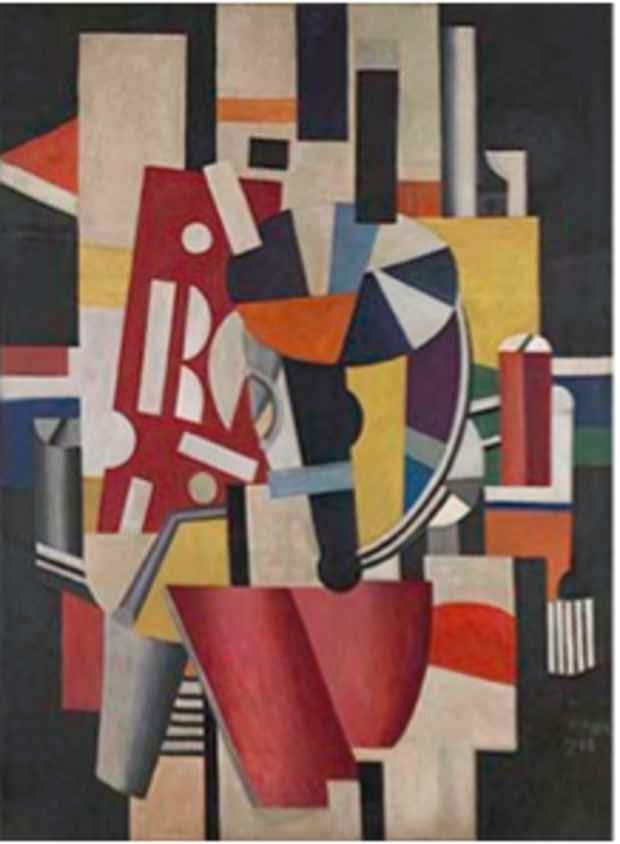
"Cubism: The Leonard
A. Lauder Collection" encompasses 81 paintings, collages, drawings and
sculptures presented as a gift to the Metropolitan Museum of Art from collector
Leonard Lauder. The works are by the four most influential Cubists: Pablo
Picasso, Georges Braque, Fernand Léger and Juan Gris. This comprehensive survey
reminds one anew just how decisive the early twentieth-century Cubist movement
was to the entire course of modern art. In shattering the illusion of
three-dimensional representation for flat, two-dimensional paintings, Cubism
paved the way for abstract art. The artists' use of collage and mixed media
broke the boundary between "high" and "low" art and brought
in popular culture. The Cubists deconstructed the everyday world–musical
instruments, human figures, landscapes, still lifes–in a radical new way that
still resonates. This exhibition is essential viewing for an understanding of
the art of the last century.
"Cubism: The Leonard A. Lauder Collection"
continues through February 16, 2015, at the Metropolitan Museum of Art, 1000 Fifth
Avenue (at 82nd Street), NYC, (212) 535-7710, www.metmuseum.org
Subscribe to:
Posts (Atom)